

Article Summary
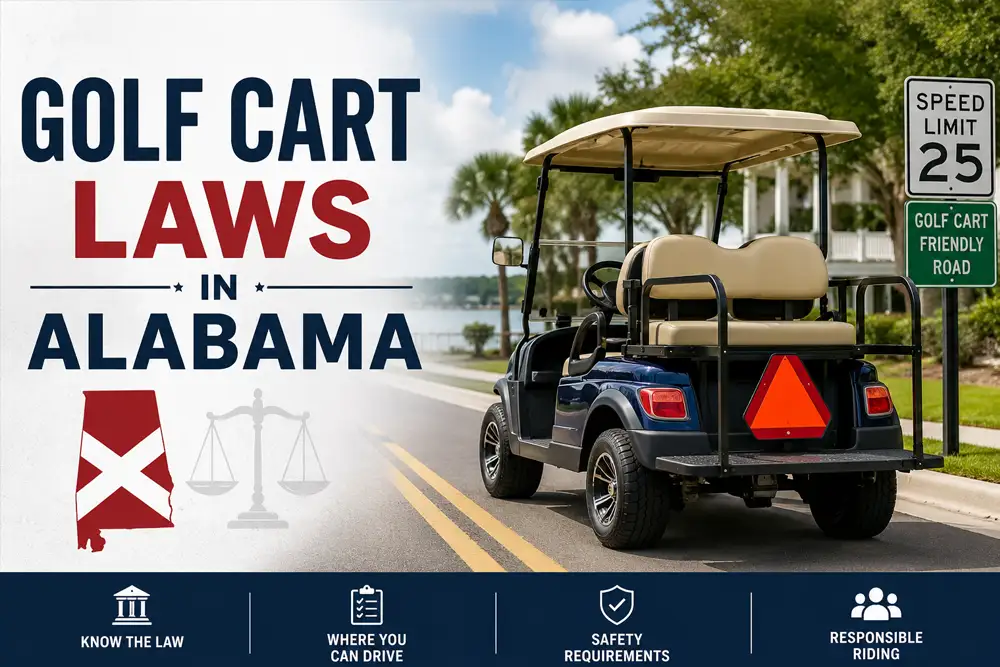
Alabama takes one of the more restrictive approaches to golf cart road use in the Southeast. Standard golf carts are not street legal on public roads anywhere in the state. Only vehicles that qualify as Low-Speed Vehicles (LSVs) under federal FMVSS 500 standards can be authorized for road use, and even then only in municipalities that meet Alabama’s Class 2 municipality classification and have passed a specific local ordinance permitting it.
That Class 2 requirement is what catches most Alabama buyers off guard. It is not enough for your city to want to allow golf carts. The city must fall into Alabama’s Class 2 municipal population category to have the legal authority to create the ordinance in the first place. Many smaller Alabama towns and rural communities do not qualify, meaning LSV road use is simply not available there regardless of how cart-friendly the local attitude might be.
The communities where LSV use is most established are along the Gulf Coast, particularly Gulf Shores, Orange Beach, Fairhope, Daphne, and Foley. Each has its own permit or registration process, and two of them add equipment requirements that go beyond the state baseline: Gulf Shores mandates an orange warning flag visible at least six feet above the ground, and Orange Beach requires headlights to be mounted no higher than 36 inches and illuminated at all times during operation.
Standard golf carts
Not street legal
LSV road access
Class 2 municipalities only
Max road speed limit
25 mph (most municipalities)
Minimum age
16 (valid license required)
Insurance
Required
Hours
Sunrise to sunset (most areas)
Why standard golf carts are not street legal in Alabama
Code of Alabama Title 32 governs motor vehicles in the state, and standard golf carts simply do not have a street-legal classification under it. Unlike states that create a separate golf cart permit or local ordinance path for standard carts, Alabama limits public road authorization to vehicles that fully qualify as LSVs under the federal definition: four-wheeled electric vehicles with top speeds between 20 and 25 mph that meet all FMVSS 500 safety standards and carry a manufacturer-assigned 17-digit VIN.
A typical golf cart modified with some lights and a mirror does not meet this standard, regardless of what equipment has been added. The vehicle itself must have been manufactured as an LSV to qualify. This is an important distinction for buyers considering a used cart conversion: the conversion path that works in some other states does not work in Alabama.
The Class 2 municipality requirement
Even for properly classified LSVs, Alabama restricts road authorization to municipalities that fall within its Class 2 population category. The state uses a tiered municipal classification system based on population, and only Class 2 cities have the authority under state law to pass the ordinances that authorize LSV use on their streets. Smaller communities, townships, and unincorporated county areas outside this classification cannot grant LSV road access even if local officials would like to.
The practical effect is that LSV road use in Alabama is concentrated in larger cities and established resort communities with sufficient population to qualify. If you live in a small Alabama town and are considering a golf cart for local transportation, verify specifically whether your municipality is authorized before making a purchase.
Required LSV equipment in Alabama
- Headlights and taillights
- Brake lights
- Turn signals
- Rearview mirror
- Seat belts
- Windshield
- Parking brake
- Horn
- Manufacturer-assigned 17-digit VIN
- Liability insurance
- Valid driver’s license (age 16+)
Individual municipalities may add requirements on top of this baseline. Gulf Shores and Orange Beach are the most prominent examples of communities that have done exactly that.
Gulf Shores and Orange Beach: community-specific rules
Gulf Shores
City permit required through the Gulf Shores Revenue Office. Standard equipment plus one unique requirement: an orange warning flag mounted so it is visible at least six feet above the ground at all times during operation. This flag rule is designed to improve visibility in beach resort traffic where taller vehicles are common. Operation limited to daylight hours and roads with speed limits of 25 mph or less.
Orange Beach
City registration required through the Orange Beach city office. Unique rule: headlights must be mounted no higher than 36 inches above the ground and must be illuminated at all times during operation regardless of time of day. This differs from the standard rule in most states where headlights are required only in low light or at night. Operation limited to sunrise to sunset on roads with speed limits of 25 mph or less.
Fairhope
Fairhope has an established LSV ordinance and registration process. The city’s layout with its downtown historic district and bayfront areas makes LSV transportation practical. Contact Fairhope City Hall for current permit requirements and authorized roads.
Daphne and Foley
Both communities have enacted LSV ordinances. Foley’s proximity to Gulf Shores makes it a natural extension of the coastal cart market. Daphne’s planned community character and waterfront areas support active LSV use. Contact each city hall for specific current requirements.
Frequently asked questions
Are golf carts street legal in Alabama?
Standard golf carts are not street legal in Alabama. Only LSVs meeting federal FMVSS 500 standards can use public roads, and only in Class 2 municipalities that have passed a local ordinance permitting it. In all other areas, no golf cart or LSV may legally operate on public roads.
What is the Class 2 municipality requirement in Alabama?
Alabama limits LSV road authorization to cities classified as Class 2 municipalities under the state’s population-based municipal system. Only these cities have the legal authority to pass ordinances permitting LSV use on their streets. Smaller communities cannot grant this authorization regardless of local preference.
How do I register a golf cart or LSV in Alabama?
Verify your city has a local LSV ordinance, then contact the city or county revenue office or police department for the local permit process. In Gulf Shores and Orange Beach, this involves an inspection and city-issued registration. Proof of liability insurance is required. The specific process varies by municipality.
What are the specific rules for Gulf Shores golf carts?
Gulf Shores requires a city permit and adds a unique orange warning flag requirement: the flag must be visible at least six feet above the ground during all operation. Operation is limited to daylight hours on roads with speed limits of 25 mph or less.
What are the specific rules for Orange Beach golf carts?
Orange Beach requires city registration and mandates that headlights be mounted no higher than 36 inches above the ground and illuminated at all times during operation, not just at night. Operation is limited to sunrise to sunset on roads with speed limits of 25 mph or less.
Is the Denago Rover XL street legal in Alabama?
In municipalities with a local LSV ordinance such as Gulf Shores, Orange Beach, Fairhope, and Daphne, yes. As a factory-built LSV with a manufacturer VIN and full FMVSS 500 compliance, it can be permitted and used on authorized roads after obtaining the required local permit. In municipalities without a local ordinance, it cannot legally operate on public roads even though it meets the technical requirements.
This page is for general informational purposes only and is not legal advice. Alabama golf cart and LSV laws vary by municipality and can change. Always verify current requirements with your local municipality and the Alabama Law Enforcement Agency before operating on public roads. Golf Cart Rating is not responsible for errors or omissions. Last reviewed June 2026.