

Article Summary
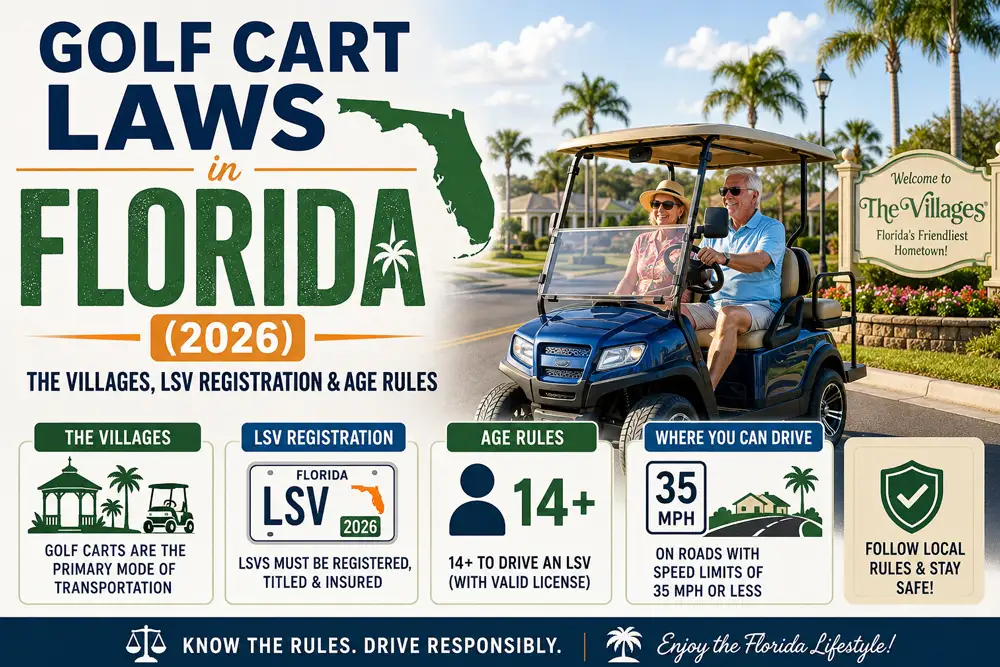
Florida is one of the most golf cart-friendly states in the country. Standard golf carts can operate on public roads that have been specifically designated for cart use by local counties or municipalities, with no state registration required. LSVs can operate on any road with a speed limit of 35 mph or less after registering with the Florida DHSMV.
The state updated its age rules in October 2023. Anyone under 18 now needs a valid learner’s permit or driver’s license to drive a golf cart on public roads. Adults 18 and older need to carry a valid government-issued photo ID.
The Villages, with over 85,000 carts, is the largest golf cart community in the world. Carts there are permitted on designated public roads with speed limits of 30 mph or less, and a separate network of tunnels and crossings handles intersections with higher-speed roads. Always confirm local county rules, as the specifics vary significantly across Florida.
Street legal
Yes (designated roads)
Max road speed limit
25 mph (carts) / 35 mph (LSVs)
Minimum age
14 (community) / 15 with permit (public roads)
Registration
Not required for golf carts / Required for LSVs
Insurance
Required for LSVs / Recommended for carts
Driver’s license
Required under 18 / Photo ID for adults
Where golf carts can legally operate in Florida
The most important thing to understand about Florida golf cart law is that a slow speed limit on a road does not automatically make it legal for golf cart use. Under Florida Statute 316.212, golf carts may only be operated on county roads or municipal streets that have been specifically designated for such use by the local government. The county or municipality must have determined that cart use is safe on that road and posted signage to indicate it.
Once a road is designated, standard golf carts with a top speed of 20 mph or less can use it without state registration. LSVs, which can reach 25 mph, are registered with the Florida DHSMV and have broader access to any road with a speed limit of 35 mph or less statewide, regardless of local designation.
The communities where this plays out most visibly are Pinellas County, Sarasota, Naples, Marco Island, and obviously The Villages. Each county manages its own network of designated roads, and the rules you follow in one county may not apply when you cross a county line.
The 2023 age rule changes
Before October 2023, Florida allowed anyone 14 years or older to drive a golf cart on designated public roads without a license. That changed. Under the updated Florida Statute 316.212(7), anyone under 18 now needs a valid learner’s permit or driver’s license to operate a golf cart on a public road. Adults 18 and older must carry a valid government-issued photo ID.
Note that these public road rules are separate from what individual communities may set for their private road networks. The Villages, for example, sets its own minimum age of 14 for community paths. But on the public roads within and around The Villages, Florida state law applies.
The Villages: what the rules actually look like
The Villages is the world’s largest golf cart community with more than 85,000 carts registered within its borders. It operates under a combination of Florida state law and its own community rules, which can be confusing if you are visiting or newly moved in.
On designated public roads within The Villages, carts are permitted on streets with posted speed limits of 30 mph or less. Carts must use marked diamond lanes where they exist, or travel along the right edge of the road where no diamond lane is available. Golf carts are not permitted on higher-speed arterial roads including US-441, US-27, CR-466, CR-466A, Rainey Trail, or Griffin Avenue. LSVs, which are registered vehicles, can use Rainey Trail and other 35 mph roads where standard carts cannot go.
At major road crossings, golf carts use an extensive network of tunnels and designated at-grade crossings rather than crossing arterials at grade. The only at-grade traffic light crossing currently permitted is on El Camino Real between Enrique Drive and Botello Avenue.
LSV registration in Florida
If you own or are purchasing a factory-built LSV, the registration process goes through the Florida DHSMV and works similarly to registering a car. You will need the manufacturer’s certificate of origin or an existing title, proof of Florida PIP insurance at a minimum of $10,000 and PDL insurance at a minimum of $10,000, and a valid Florida driver’s license.
Factory-built LSVs like the Denago Rover XL come with a manufacturer-assigned VIN and meet all federal FMVSS 500 safety equipment requirements from the factory, so the registration process is straightforward. If you are converting a standard golf cart to an LSV classification, Florida requires you to bring the modified vehicle to a Motorist Services Regional Office for a VIN inspection and submit additional paperwork including Form HSMV 86064.
- Headlamps
- Taillamps and brake lights
- Turn signals
- Windshield
- Mirrors (rearview and side)
- Seat belts
- Parking brake
- Reflectors
- 17-digit manufacturer VIN
- Florida DHSMV title and registration
- PIP and PDL insurance
Insurance for golf carts in Florida
Standard golf carts on designated public roads are not required by the state to carry insurance. That said, given the density of cart traffic in communities like The Villages and Pinellas County, an accident is far more likely than in most states. A standalone golf cart liability policy typically runs $60 to $375 per year depending on coverage, cart value, and your location. Given that figure, it is hard to justify going without one.
LSVs require Florida PIP and PDL coverage just like any registered vehicle. This is not optional and you cannot complete registration without proof of insurance.
Frequently asked questions
Are golf carts street legal in Florida?
Yes, but only on roads that your local county or municipality has specifically designated for golf cart use. A low speed limit alone is not enough. The local government must have authorized cart use and posted signage. LSVs registered with the Florida DHSMV can operate on any road with a speed limit of 35 mph or less statewide.
What are the age rules for driving a golf cart in Florida in 2026?
As of October 1, 2023, anyone under 18 must have a valid learner’s permit or driver’s license to operate a golf cart on public roads. Adults 18 and older must carry a valid government-issued photo ID. On private community paths, the community’s own age rules may differ, but state law governs public roads.
Does The Villages require registration or insurance for golf carts?
Florida state law does not require registration or insurance for standard golf carts on designated roads. However, with over 85,000 carts in The Villages and a high accident rate, insurance is strongly recommended. Annual policies typically run $60 to $375. If you are driving an LSV, registration and PIP/PDL insurance are required by state law.
How do I register an LSV in Florida?
Title and register with the Florida DHSMV using the manufacturer’s certificate of origin, proof of PIP insurance at a minimum of $10,000, PDL insurance at $10,000, and a valid Florida driver’s license. Factory-built LSVs like the Denago Rover XL can be registered directly. Converting a golf cart to an LSV requires an in-person VIN inspection at a Motorist Services Regional Office.
Is the Denago Rover XL street legal in Florida?
Yes. It is a factory-built LSV meeting all FMVSS 500 requirements, can be registered with the Florida DHSMV, and may operate on any road with a speed limit of 35 mph or less including roads where standard golf carts are not permitted.
Can I drive a golf cart on the sidewalk in Florida?
Only if your local government has passed an ordinance specifically allowing it. State rules cap sidewalk use at 15 mph and require the sidewalk to be at least 8 feet wide where it runs adjacent to a state highway. Most communities do not authorize sidewalk driving.
This page is for general informational purposes only and is not legal advice. Golf cart laws change frequently at the state, county, and municipal level. Always verify current requirements with the Florida DHSMV, your local county, and your community before operating on public roads. Golf Cart Rating is not responsible for errors or omissions. Last reviewed June 2026.