

Article Summary
Georgia does not use the term golf cart in its primary road-use statute. What most people call a street-legal golf cart is classified in Georgia law as a Personal Transportation Vehicle, or PTV. Under O.C.G.A. 40-1-1, a PTV is any motor vehicle with at least four wheels, a top speed under 20 mph, and an unladen weight under 1,375 pounds. That classification is what qualifies a vehicle for use under the local ordinance framework.
PTVs can only operate on public streets where a local government has passed an ordinance under O.C.G.A. 40-6-331 designating specific roads for combined PTV and regular traffic use. Without that ordinance, driving a PTV on public streets is not legal. Georgia does not require state DMV registration for PTVs. Instead, any registration happens at the local level and varies by city.
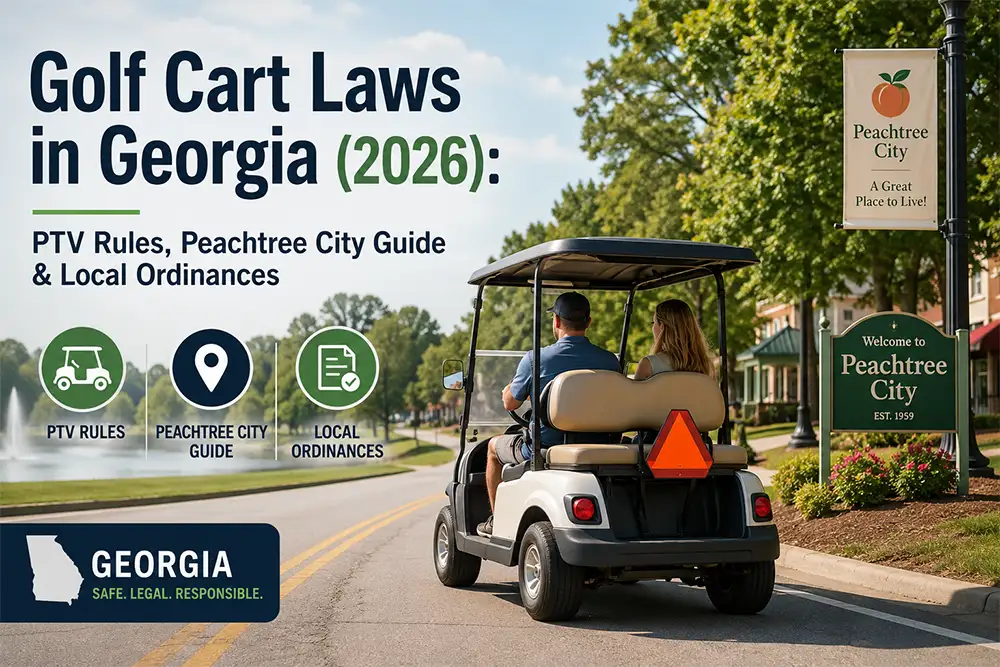
Peachtree City is the most famous example of the Georgia framework working at scale. Founded as a planned community in 1959, it has more than 100 miles of paved multi-use paths connecting its five villages, and over 10,000 registered carts. Many residents run daily errands without using a car. The city requires registration within 10 days of purchase, and as of 2026 updated the decal placement rules to require stickers on both the front and rear of every cart.
Statewide street legal
No (local ordinance required)
PTV max speed
Under 20 mph
Minimum age (state)
16 with valid license
State registration
Not required for PTVs
Local registration fee
Varies (up to $15 max by law)
Insurance
Recommended, varies by city
Georgia’s PTV framework explained
The first thing to understand about Georgia golf cart law is the terminology. What Georgia law actually governs for street use is a Personal Transportation Vehicle, defined under O.C.G.A. 40-1-1 as a vehicle with at least four wheels, a top speed under 20 mph, a maximum unladen weight of 1,375 pounds, and the capacity to carry no more than eight people. A strict golf cart in Georgia law is actually narrower: a vehicle with an average speed under 15 mph designed exclusively for golf course use.
In practice, the PTV classification is what covers the vast majority of carts people actually drive on Georgia streets. If your cart has been modified to go faster than 15 mph but stays under 20 mph, Georgia considers it a PTV rather than a golf cart.
| Category | Georgia definition | Street use path |
|---|---|---|
| Golf cart | Average speed under 15 mph, designed for golf courses | Golf courses and private property only |
| PTV | Top speed under 20 mph, 4 wheels, under 1,375 lbs | Roads designated by local ordinance under O.C.G.A. 40-6-331 |
| LSV | 20 to 25 mph, FMVSS 500 compliant, manufacturer VIN | State DMV registration, any road up to 35 mph |
What local ordinances cover and what they cannot do
O.C.G.A. 40-6-331 gives local governing bodies the authority to designate specific public streets for combined PTV and regular traffic use and to set operating standards. However, there is a cap on what they can charge: local registration fees cannot exceed $15, and the registration license is permanently attached to the cart unless it is sold or destroyed.
Local ordinances cannot impose general inspection requirements or broadly expand the PTV definition. What they can do is identify which roads are permitted, set the equipment requirements for those roads, define operating hours, and establish the local registration process. The statute does not require cities to act: many Georgia communities have never passed an ordinance and have no framework for PTV road use.
Required equipment when driving on designated streets
For PTVs authorized under a local ordinance, Georgia O.C.G.A. 40-6-330.1 specifies the minimum equipment required when driven on public streets after dark or under low visibility:
- Headlights
- Brake lights and taillights
- Turn signals
- Horn
- Rearview mirror
- Reflex reflectors
- Parking brake
- Slow-moving vehicle emblem (when on public streets)
PTVs must stay on roads with speed limits of 35 mph or less, obey all traffic signs and signals, and not exceed 20 mph. Driving a PTV on a road with a posted speed limit above 35 mph is illegal regardless of what a local ordinance says.
Peachtree City: the most developed golf cart system in Georgia
Peachtree City built cart paths into its master plan in 1959, and in 1974 Georgia Governor Jimmy Carter signed legislation enabling residents to drive carts on public roads in the city. Today the path network connects Aberdeen, Braelinn, Glenloch, Kedron, and Wilksmoor villages to schools, shopping centers, medical parks, three lakes, and recreation facilities. Where a path runs parallel to a street, cart use on the path is mandatory rather than optional.
Registration is required within 10 days of purchase and is done in person at City Hall. In October 2025, the City Council updated the decal placement rules: decals must now be affixed to both the front and rear of the cart in unobstructed, clearly legible locations. New decals reflecting this requirement were mailed with the 2026 renewal notices.
Peachtree City’s age rules for its path network are more permissive than Georgia state law. Anyone 16 or older can operate on city paths without a driver’s license. Age 15 can operate with a valid learner’s permit. Ages 12 to 14 can operate only when accompanied in the front seat by a parent, grandparent, legal guardian, or a licensed adult who is at least 18. Children under 12 cannot operate a cart on paths or public roads.
Other Georgia communities with active cart ordinances
Roswell passed an ordinance allowing PTVs on city streets with speed limits of 25 mph or less, with a local permit costing $15 and renewable every five years. Sea Island and St. Simons Island have long histories of golf cart use with their own community frameworks. Jekyll Island operates under a state-managed framework since it is a state property. Many coastal and Lowcountry communities have established cart-friendly areas, and the number of Georgia cities passing ordinances has grown steadily in recent years.
Frequently asked questions
Are golf carts street legal in Georgia?
Not statewide. Georgia allows Personal Transportation Vehicles (PTVs) on public streets only where a local government has passed an ordinance under O.C.G.A. 40-6-331 designating specific roads for combined cart and vehicle use. Without that local ordinance, operating on public streets is not legal.
What is a Personal Transportation Vehicle (PTV) in Georgia?
Under O.C.G.A. 40-1-1, a PTV has at least four wheels, a top speed under 20 mph, an unladen weight under 1,375 pounds, and seats for no more than eight people. Most street-driven golf carts in Georgia fall into this category. A strict golf cart under Georgia law is defined more narrowly as designed for golf courses with an average speed under 15 mph.
How do I register a golf cart in Georgia?
Georgia does not require state DMV registration for PTVs. Registration happens locally where a city ordinance requires it. In Peachtree City, you register in person at City Hall within 10 days of purchase: $45 for a three-year residential cycle, $250 per year for non-residents. Roswell charges $15 for a five-year permit. Other cities have their own processes. Contact your city hall to find out what applies in your area.
Do I need a driver’s license to drive a golf cart in Georgia?
Georgia state law requires a valid driver’s license for PTV use on public roads, with a 15-year-old learner’s permit exception if a licensed adult accompanies in the front seat. Peachtree City’s own path network has more permissive rules: age 16 can drive without a license on city paths, age 15 can drive with a learner’s permit, and ages 12 to 14 can drive with an eligible adult in the front seat.
How does Peachtree City’s golf cart system work?
Over 100 miles of paved multi-use paths connect all five of the city’s villages to schools, shopping, and recreation. Where paths run parallel to a street, path use is mandatory. Registration is required within 10 days of purchase at City Hall. As of 2026, decals must be affixed to both the front and rear of the cart.
Is the Denago Rover XL street legal in Georgia?
The Denago Rover XL’s top speed puts it above the 20 mph PTV threshold, so it must register as an LSV through the Georgia DOR Motor Vehicle Division rather than operating under a local PTV ordinance. As a registered LSV it has broader road access. Confirm with your local authority about which roads are open to registered LSVs in your area.
This page is for general informational purposes only and is not legal advice. Georgia golf cart and PTV laws vary by city and are subject to local ordinance changes. Always verify current requirements with your local government and the Georgia Department of Public Safety before operating on public roads. Golf Cart Rating is not responsible for errors or omissions. Last reviewed June 2026.