

Article Summary
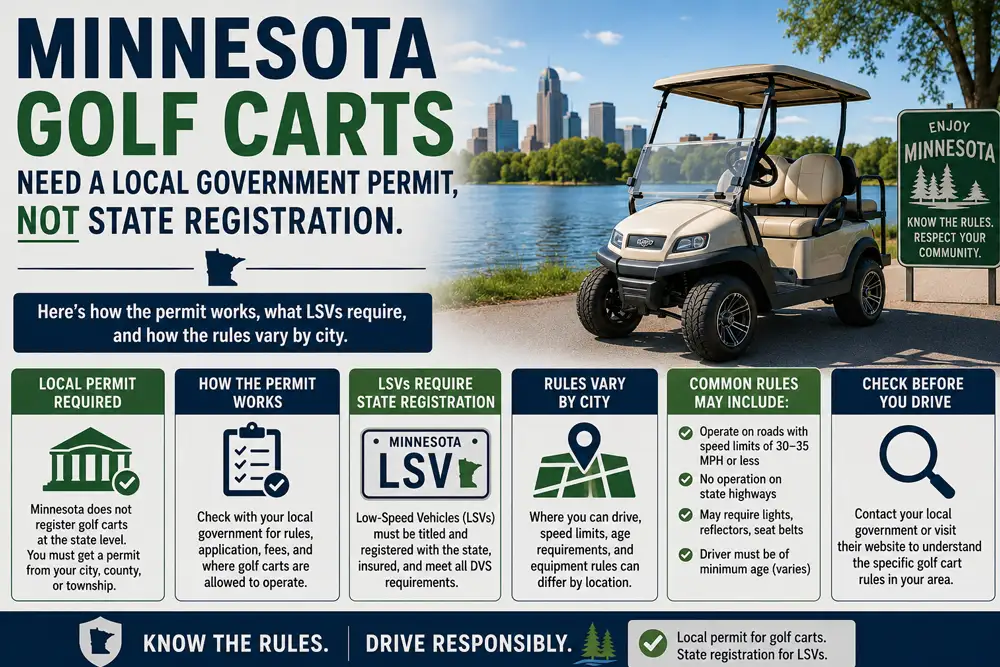
Minnesota does not authorize golf carts on public roads statewide. Instead, Minnesota Statute 169.045 gives local governments the authority to issue permits allowing golf cart use on their specific roads. If your city or township has not passed such an ordinance, golf cart use on public streets is not legal in your area regardless of the speed limit.
Where a local permit system is in place, golf carts operate under that local framework. They are not registered with the Minnesota DVS and do not receive state license plates. The permit, issued by your city or county, is valid for up to three years and specifies which roads are allowed, equipment requirements, and any age or insurance conditions.
Factory-built LSVs like the Denago Rover XL are treated completely differently. They carry a manufacturer-assigned VIN, register and title through the Minnesota DVS, and can operate on any road with a speed limit of 35 mph or less statewide without needing a local permit ordinance.
Statewide street legal
No (local permit required)
Max road speed limit
30 mph (carts) / 35 mph (LSVs)
Minimum age
Set by local ordinance
Registration
Local permit / DVS for LSVs
Insurance
Required (Statute 169.045)
Driver’s license
Varies by local ordinance
The Minnesota local permit system
Minnesota Statute 169.045 is the foundation for golf cart road use in the state. It authorizes local governments, including cities, counties, and townships, to pass ordinances allowing golf carts on their roads and to issue permits to cart operators. The state is not granting broad permission. It is giving local governments a tool they can choose to use or not use.
When a local government passes an ordinance, it defines the conditions for cart use in that jurisdiction. Permits issued under the ordinance are valid for up to three years and can be renewed. Golf carts operating under this system are not titled or registered through the Minnesota Department of Public Safety Driver and Vehicle Services. They do not receive state license plates. The permit is the authorization, and it is specific to the roads and conditions defined in that local ordinance.
Minnesota Statute 169.045 does require evidence of insurance for golf carts operating under a local permit, so some form of liability coverage is not optional even at the local level.
Golf carts vs LSVs: the key distinction
Minnesota draws a meaningful line between a standard golf cart operating under a local permit and a factory-built LSV registered through the state. Here is how they compare:
| Category | Golf cart (local permit) | LSV (DVS registration) |
|---|---|---|
| State registration | Not registered with DVS | Titled and registered with DVS |
| VIN | Not required | Manufacturer-assigned 17-digit VIN required |
| Road access | Roads permitted by local ordinance (typically 30 mph or less) | Any road with speed limit of 35 mph or less statewide |
| Federal safety standards | Basic equipment per local ordinance | Full FMVSS 500 compliance required |
| Insurance | Required under Statute 169.045 | Standard motor vehicle insurance required |
| Driver’s license | Varies by local ordinance | Required |
The practical implication is that if you live in a city with an active golf cart ordinance and only plan to drive within that community, the local permit route works. If you want statewide road access without depending on whether a local ordinance is in place, an LSV registration is the more flexible path.
Age and license requirements
This is one of the more genuinely variable aspects of Minnesota golf cart law. The state permit statute expressly states that the standard driver’s license requirement under Chapter 171 does not apply to golf carts operated under a local permit. That means there is no single statewide minimum age or license requirement for cart use under the permit system.
Individual cities fill that gap by setting their own conditions in their ordinances. Many Minnesota cities require a valid driver’s license. Some set a minimum age of 16. Others may differ. The only way to know what applies in your area is to read the specific ordinance your city has enacted.
For LSVs, the rules are consistent: a valid driver’s license is required since the vehicle is registered as a motor vehicle.
Where golf carts are commonly used in Minnesota
The most active golf cart communities in Minnesota tend to be lake resort areas and northern tourism towns. The Brainerd Lakes area has a long history of cart use in its many lake communities. Prior Lake, smaller northern resort towns, and communities around Mille Lacs, Leech Lake, and the Boundary Waters corridor are all areas where cart use is common during warmer months.
If you are spending time in one of these communities, the local hardware store or rental operation will usually know exactly what the local ordinance requires. It is faster than navigating the county website in most cases.
Frequently asked questions
Are golf carts street legal in Minnesota?
Not statewide. Minnesota Statute 169.045 allows local governments to authorize golf cart use on their roads through a permit system. If your city or town has not passed such an ordinance, golf carts are not legal on public roads in your area.
How does the Minnesota golf cart permit system work?
Your local government issues permits allowing golf cart use on designated roads under Minnesota Statute 169.045. Golf carts operating under this system are not registered through the Minnesota DVS. Permits are valid for up to three years and can be renewed. The ordinance sets all conditions including roads, equipment, age, and insurance.
Do I need a driver’s license to drive a golf cart in Minnesota?
The state permit statute does not require a driver’s license for golf carts operating under a local permit, but many cities set their own license or age requirements in their ordinances. Check your specific local ordinance. For LSVs registered through the DVS, a valid driver’s license is required.
What is the difference between a golf cart and an LSV in Minnesota?
A golf cart uses the local permit system, is not registered with the DVS, and can only access roads permitted by local ordinance. An LSV has a manufacturer-assigned 17-digit VIN, is registered and titled through the DVS, and can operate on any road with a speed limit of 35 mph or less statewide.
Is the Denago Rover XL street legal in Minnesota?
Yes. It is a factory-built LSV that can be registered through the Minnesota DVS for statewide road access on streets with speed limits up to 35 mph. It does not depend on a local golf cart ordinance being in place.
Do I need insurance for a golf cart in Minnesota?
Yes. Minnesota Statute 169.045 requires evidence of insurance for golf carts operating under a local permit. LSVs require full motor vehicle insurance. A standalone liability policy is worth having in either case.
This page is for general informational purposes only and is not legal advice. Golf cart laws change at the state, county, and municipal level. Always verify current requirements with your local government and the Minnesota DVS before operating on public roads. Golf Cart Rating is not responsible for errors or omissions. Last reviewed June 2026.