
Article Summary
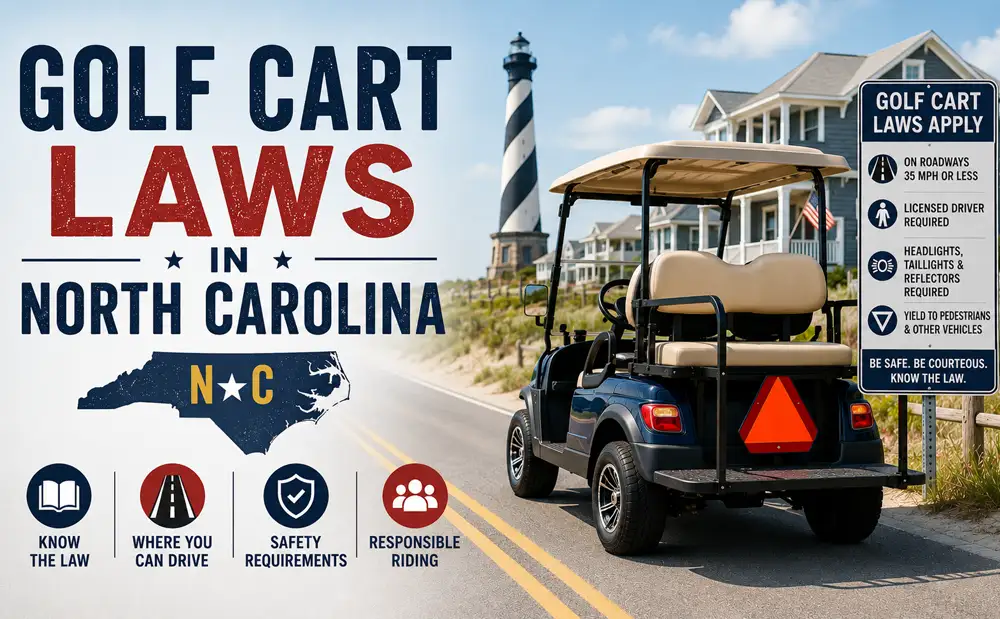
North Carolina operates a two-track system for golf carts and LSVs on public roads. Standard golf carts have no automatic right to any public road statewide. They can only be driven where a municipality or county has passed an ordinance under G.S. 160A-300.6 specifically designating roads for golf cart use. Without that local ordinance, operating a golf cart on a public road in North Carolina is illegal regardless of the speed limit posted on that road.
LSVs are different. A vehicle that meets the federal FMVSS 500 standards, carries a manufacturer-assigned 17-digit VIN, and is registered with the NCDMV under G.S. 20-121.1 has statewide access to any road with a speed limit of 35 mph or less, without needing a local ordinance.
North Carolina has one of the strictest LSV conversion rules in the country. Only a licensed manufacturer can legally convert a golf cart into an LSV in North Carolina. The manufacturer must issue the VIN, provide a Manufacturer’s Certificate of Origin, and certify compliance with all applicable NHTSA, NC General Statute, and NC Administrative Code requirements. You cannot do this conversion yourself and then register the result with the NCDMV.
Statewide street legal
No (local ordinance required)
LSV road access
Any road up to 35 mph
Minimum age
16 (valid license required)
NCDMV registration
Required for LSVs
Insurance
Required (local and LSV)
DIY conversion
Not allowed — manufacturer only
The two-track system: golf carts vs LSVs
North Carolina General Statute 160A-300.6 gives municipalities the authority to regulate golf cart operation on city streets and roads with speed limits of 35 mph or less. Counties can do the same for unincorporated areas. When a local government passes such an ordinance, it sets the conditions: which roads, what equipment, minimum age, insurance requirements, and whether a decal or local permit is required. Without that ordinance, golf cart use on those roads is simply not authorized.
LSVs operate under a separate and statewide framework. G.S. 20-121.1 governs low-speed vehicles in North Carolina and defines them as four-wheeled electric vehicles with top speeds between 20 and 25 mph. An LSV registered with the NCDMV can use any road with a posted speed limit of 35 mph or less without needing a local ordinance to authorize it. This is the meaningful advantage of the LSV path over the local ordinance path.
The manufacturer-only conversion rule
This rule is stricter than most states. In many states, a sufficiently equipped cart can be inspected and registered regardless of who installed the equipment. North Carolina specifically requires the work to be done by a licensed manufacturer who takes legal responsibility for certifying the vehicle. For buyers who already own a standard golf cart and want street access, this means the conversion path is either expensive (finding a licensed manufacturer to certify the work) or impractical, and purchasing a factory-built LSV is the more realistic option.
What local golf cart ordinances typically require
While the specifics vary by municipality, most North Carolina communities that have passed ordinances under G.S. 160A-300.6 include conditions along these lines:
- Operator must be at least 16 with a valid driver’s license
- Headlights and taillights required for operation near dawn or dusk
- Rearview mirror
- Slow-moving vehicle emblem displayed on public streets
- Liability insurance at NC motor vehicle minimums
- Local decal or registration (varies by municipality)
- Limited to roads with speed limits of 35 mph or less
- Daylight operation only in most communities
Some communities add a one-mile radius restriction similar to South Carolina’s four-mile rule. Others limit carts to specific road segments. The model ordinance published by NCDOT includes language noting that the municipality does not endorse golf cart use on roads and that all operators proceed at their own risk. This is North Carolina’s way of passing authorization while making clear the liability lies with the operator.
The Outer Banks and coastal NC communities
The Outer Banks is where North Carolina golf cart culture is most visible. Duck has an established ordinance permitting golf cart use on town roads with speed limits of 25 mph or less. Corolla, Southern Shores, and Kitty Hawk each approach it differently. Because these are separate incorporated towns and unincorporated county areas, the rules can shift meaningfully within a few miles. What is legal in Duck may not be legal when you cross into another jurisdiction. If you are visiting or vacationing in the Outer Banks, confirm the rules for the specific town you are staying in rather than assuming the same rules apply everywhere on the Banks.
Pinehurst, with its golf resort community character, has a long history of cart-friendly infrastructure. Ocean Isle Beach, Sunset Beach, and Brunswick County beach towns have also enacted ordinances as cart use has grown in those communities. The number of NC municipalities passing golf cart ordinances has increased steadily over the past several years.
Frequently asked questions
Are golf carts street legal in North Carolina?
Standard golf carts are not automatically street legal. Under G.S. 160A-300.6, municipalities can pass ordinances allowing golf cart use on roads with speed limits of 35 mph or less. Without a local ordinance, driving on public roads is illegal. LSVs registered with the NCDMV under G.S. 20-121.1 have statewide access to roads up to 35 mph without needing a local ordinance.
Can I convert my golf cart to a street-legal LSV in North Carolina?
Not on your own. The NCDMV requires the conversion to be performed by a licensed manufacturer who issues a 17-digit VIN, a Manufacturer’s Certificate of Origin, and certifies compliance with all NHTSA and NC requirements. DIY conversions are not accepted by the NCDMV regardless of what equipment is installed.
What does a local ordinance in North Carolina typically require?
Most NC municipalities require the operator to be at least 16 with a valid driver’s license, carry liability insurance, have headlights and taillights for use near dawn or dusk, display a slow-moving vehicle emblem, and limit operation to designated roads with speed limits of 35 mph or less. Some add a local decal or one-mile radius restriction.
Do I need insurance for a golf cart in North Carolina?
Most local ordinances require liability insurance at NC motor vehicle minimum levels. LSVs registered with the NCDMV require the same insurance as any registered motor vehicle. Liability coverage is strongly recommended regardless of the technical requirement in your specific area.
Is the Denago Rover XL street legal in North Carolina?
Yes. It is a factory-built LSV with a manufacturer VIN and full FMVSS 500 compliance, satisfying North Carolina’s manufacturer-only conversion requirement without additional work. It registers with the NCDMV for statewide access to roads up to 35 mph.
What are the golf cart rules at the Outer Banks?
Several Outer Banks towns including Duck have passed local ordinances permitting golf cart use on designated roads with speed limits of 25 mph or less. The rules vary between towns. Verify with the specific municipality you plan to drive in before assuming the same rules apply throughout the Banks.
This page is for general informational purposes only and is not legal advice. Golf cart laws change at the state, county, and municipal level. Always verify current requirements with the NCDMV at ncdot.gov/dmv and your local government before operating on public roads. Golf Cart Rating is not responsible for errors or omissions. Last reviewed June 2026.