

Article Summary
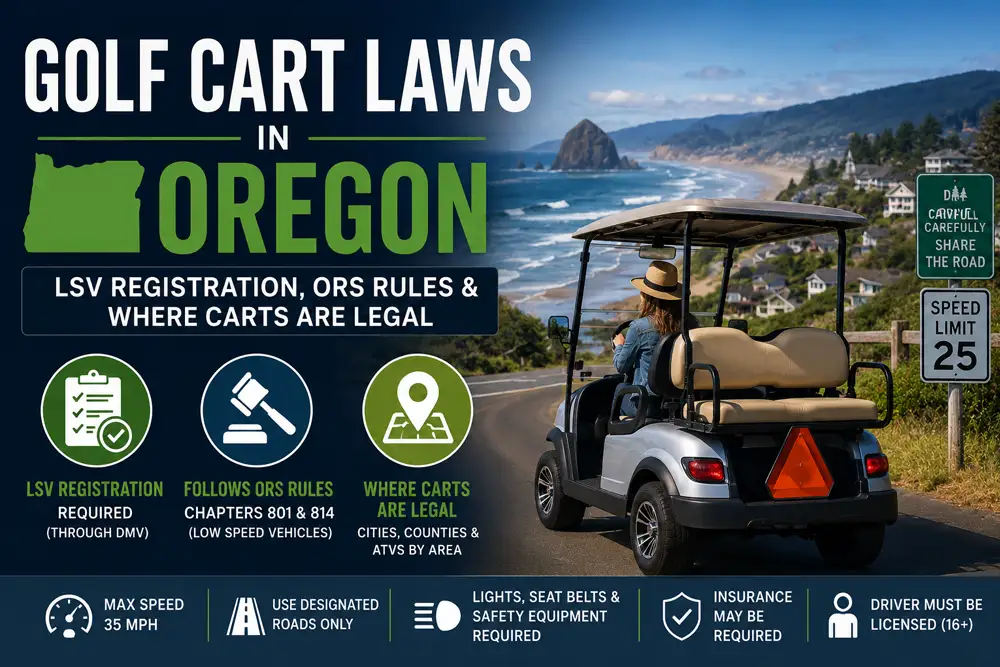
Oregon draws a firm legal line between golf carts and low-speed vehicles, and that distinction determines everything about where you can drive. Under ORS 801.295, a golf cart in Oregon is defined as a vehicle with a top speed of 15 mph or less designed for carrying golf equipment and two people. That narrow definition means most modern golf carts sold today do not qualify as golf carts under Oregon law at all, since they routinely reach 20 to 25 mph.
Standard golf carts have no automatic right to any Oregon public road. The only path to street use for a traditional cart is a local municipal ordinance under ORS 810.070, and only a handful of Oregon communities have enacted one. Outside of those specific local exceptions, you need a vehicle that qualifies as an LSV to drive legally on public roads.
LSVs registered with the Oregon DMV can operate on any road with a speed limit of 35 mph or less statewide. They must meet full federal FMVSS 500 safety standards, carry a manufacturer-assigned 17-digit VIN, and be insured. A valid driver’s license is required. Factory-built LSVs like the Denago Rover XL are the simplest path to legal road use in Oregon.
Standard golf carts
Not street legal (local exceptions only)
LSVs
Legal on roads up to 35 mph
Minimum age
16 (license required)
Registration
Oregon DMV (LSVs only)
Insurance
Required for LSVs
Driver’s license
Required
How Oregon defines a golf cart under state law
ORS 801.295 sets a surprisingly narrow definition. To be classified as a golf cart in Oregon, the vehicle must have at least three wheels on the ground, weigh under 1,300 pounds unloaded, have a top speed of 15 mph or less, and be designed for carrying golf equipment and no more than two people. That 15 mph ceiling is what catches most buyers off guard. If your cart can reach 18, 20, or 25 mph, it does not meet Oregon’s golf cart definition and must be registered as an LSV instead.
Golf carts as Oregon defines them are exempt from registration under ORS 820.210 when operated under a local ordinance. But that exemption only matters where an ordinance actually exists, and very few Oregon municipalities have enacted one.
LSV registration in Oregon
This is the primary legal path to public road use for almost every cart owner in Oregon. An LSV must have a top speed between 20 and 25 mph, meet all federal FMVSS 500 safety standards, carry a manufacturer-assigned 17-digit VIN, and be registered and titled through the Oregon DMV. After registration you carry standard no-fault automobile insurance rather than motorcycle insurance, and you can operate on any road with a posted speed limit of 35 mph or less statewide.
The required equipment for LSV registration includes:
- Headlights and taillights
- Brake lights
- Front and rear turn signals
- Rearview and side mirrors
- Seat belts for all occupants
- Windshield
- Parking brake
- Speedometer
- Horn
- Manufacturer-assigned 17-digit VIN
- Oregon DMV registration and license plate
- No-fault automobile insurance
Oregon does not require a separate inspection for factory-built LSVs that arrive with a manufacturer’s certificate of origin and a VIN already assigned. The process is similar to registering a new car. If you are attempting to convert a standard golf cart into an LSV, the process is significantly more involved and may not be practical or cost-effective compared to purchasing a factory-built LSV.
Local ordinance exceptions under ORS 810.070
ORS 810.070 gives the Oregon Department of Transportation the authority to adopt rules allowing golf cart operation on specific highways, and separately gives municipalities the ability to pass their own local ordinances. A handful of Oregon communities have exercised this authority, mostly along the coast and in resort areas. Manzanita enacted an ordinance allowing low-speed vehicles meeting specific conditions on public streets with speed limits of 25 mph or less. Sunriver operates as a private resort community with its own dedicated path network that carts use extensively.
Outside of those specific communities, do not assume that a low speed limit on a road makes it legal for golf cart use. In Oregon, that is not how it works. If you live in or are visiting an Oregon community and want to know whether carts are permitted, contact your city or county directly and ask whether an ordinance exists under ORS 810.070.
Frequently asked questions
Are golf carts street legal in Oregon?
Standard golf carts (15 mph or less under ORS 801.295) are not street legal on Oregon public roads by default. They can only operate on public roads where a local municipality has enacted an ordinance under ORS 810.070. Outside those specific local exceptions, a vehicle must qualify as an LSV and register with the Oregon DMV to legally use public roads.
What qualifies as a golf cart under Oregon law?
ORS 801.295 defines a golf cart as a vehicle with at least three wheels, under 1,300 pounds unloaded, a top speed of 15 mph or less, and designed for golf equipment and no more than two people. Most modern golf carts reach 20 to 25 mph and therefore do not meet this definition. They must register as LSVs instead.
How do I register an LSV in Oregon?
LSVs must meet all FMVSS 500 federal safety standards, carry a manufacturer-assigned 17-digit VIN, and register and title with the Oregon DMV. No-fault automobile insurance is required. Factory-built LSVs like the Denago Rover XL come with all required equipment and a manufacturer’s certificate of origin, making the registration process similar to buying a new car.
Do I need a driver’s license to drive a golf cart or LSV in Oregon?
Yes. Oregon requires a valid driver’s license to operate an LSV on public roads. The minimum age is 16. For golf carts operating under a local municipal ordinance, the local ordinance governs, but a license or equivalent driving credential is generally expected.
Is the Denago Rover XL street legal in Oregon?
Yes. It is a factory-built LSV meeting all FMVSS 500 requirements. It registers with the Oregon DMV and can operate statewide on roads with speed limits up to 35 mph.
Which Oregon cities allow golf carts on public roads?
A small number of Oregon coastal and resort communities have passed local ordinances under ORS 810.070. Manzanita is one known example. Sunriver is a private resort with its own path network. Always verify directly with your municipality before assuming local permission exists.
This page is for general informational purposes only and is not legal advice. Golf cart and LSV laws change at the state and local level. Always verify current requirements with the Oregon DMV and your local municipality before operating on public roads. Golf Cart Rating is not responsible for errors or omissions. Last reviewed June 2026.