

Article Summary
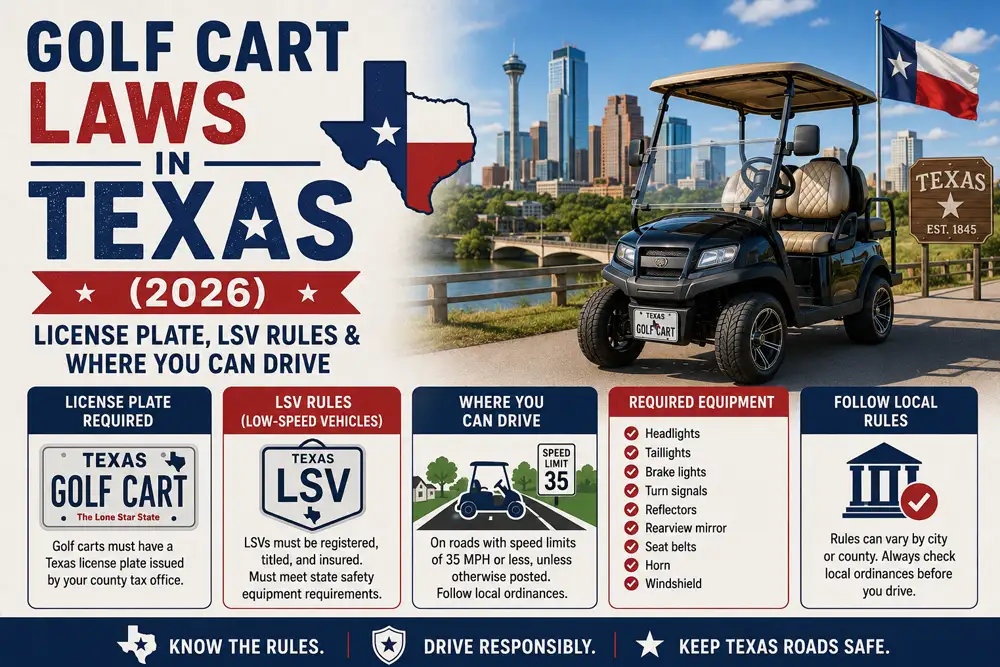
Texas is one of the most golf cart-friendly states in the country, but it has a registration system that works differently from almost everywhere else. Standard golf carts do not go through the TxDMV title process. Instead, you get a Texas golf cart license plate from your county tax assessor-collector’s office, which authorizes limited road use under Texas Transportation Code Chapter 551.
Factory-built LSVs like the Denago Rover XL follow a completely separate path. They carry a manufacturer-assigned 17-digit VIN and register with TxDMV as a standard motor vehicle, which gives them broader road access across the state without depending on local ordinances.
A valid driver’s license is required for public road use in both cases. Local municipalities control where carts can operate, so always verify your specific city or town’s rules before driving on public streets.
Street legal
Yes
Max road speed limit
35 mph
Minimum age
16 (license required)
Registration
Golf cart plate required
Insurance
Required
Driver’s license
Required
How Texas handles golf cart registration differently
Most states either treat golf carts like motor vehicles or ban them from public roads entirely. Texas took a third path. Under Texas Transportation Code Section 551.402, standard golf carts are not titled or registered through TxDMV. Instead, the state issues a specific golf cart license plate through each county’s tax assessor-collector’s office. That plate is what makes your cart legal for limited public road use.
Getting one is straightforward. You bring proof of ownership (a manufacturer’s certificate of origin for new carts or a bill of sale), proof of liability insurance, and the required fee to your county tax assessor-collector. The plate is then what authorizes you to operate on public roads under the conditions Chapter 551 outlines.
It is worth understanding that the plate alone does not make your cart legal everywhere. Local municipalities still determine which roads within their borders are open to golf carts. A city like Galveston or Port Aransas has long had cart-friendly ordinances in place. An inland suburb may restrict carts entirely. Always verify your specific city’s rules before assuming the plate covers you on any road.
What equipment your cart must have
Texas law requires golf carts operating on public roads to be equipped with the following:
- Headlamps
- Taillamps
- Brake lights
- Reflectors
- Rearview mirror
- Parking brake
- Texas golf cart license plate
- Liability insurance
- Valid driver’s license for the operator
Turn signals are not specifically required for a standard golf cart under state law but are required equipment if your vehicle is classified as an LSV. Given that most modern carts include them, it is worth verifying what your specific model has before driving on roads where other drivers expect turn signals.
Where you can legally drive in Texas
Texas law sets up four situations where golf cart road use is permitted. You can drive on public roads with posted speed limits of 35 mph or less when your city or county has authorized it. You can operate within master-planned communities that have approved golf cart use on their internal roads, even when those roads are technically public. Beach communities and coastal areas are another common category, with places like Galveston, Port Aransas, and Rockport having long histories of cart traffic. Finally, there are narrow exceptions for short-distance transportation on certain low-speed roads that are tied to access between a residence and a service.
The key takeaway is that a 35 mph speed limit on a road does not automatically mean you can drive there. The local authority needs to have authorized it. The most cart-friendly areas in Texas include Galveston Island, Port Aransas, South Padre Island, Fredericksburg, Wimberley, Canyon Lake communities, and many of the Hill Country resort towns where cart use is deeply established.
LSVs in Texas: a different registration path
Factory-built low-speed vehicles follow a completely different process. An LSV like the Denago Rover XL arrives with a manufacturer-assigned 17-digit VIN and meets federal FMVSS 500 safety standards from the factory. These vehicles go through TxDMV title and registration just like any other car or truck, and they carry standard Texas license plates rather than the golf cart plate.
The advantage of going the LSV route is that your vehicle has statewide road access on any road with a speed limit of 35 mph or less without needing a local ordinance to authorize it. You are treated like any other registered motor vehicle. The tradeoff is that full TxDMV registration requires a title, proof of insurance, and the vehicle must meet all the federal safety equipment requirements. For buyers purchasing a factory-built LSV, the manufacturer handles most of this during the sale.
Age and license requirements
Texas requires a valid driver’s license to operate a golf cart on a public road. Since the standard licensing age in Texas is 16, that is effectively the minimum age for driving a cart on public streets. The one exception is for drivers with a learner’s permit, who can operate a golf cart on a public road as long as they are accompanied in the front seat by a licensed driver who is at least 18 years old. These rules apply equally to LSVs since they are registered motor vehicles.
On private property, a golf course, or within a gated community’s private road network, these public road rules generally do not apply. But once you pull out onto a public street, you need a license.
Insurance requirements
Liability insurance is required to obtain the golf cart license plate and to drive legally on Texas roads. For LSVs, the same insurance requirements that apply to any registered vehicle apply here. Even if you only plan to drive on private property most of the time, a standalone golf cart liability policy is worth having given how quickly medical costs and property damage add up if something goes wrong with passengers involved.
Frequently asked questions
Are golf carts street legal in Texas?
Yes, golf carts are street legal in Texas on roads with a posted speed limit of 35 mph or less, provided the cart has required safety equipment and displays a Texas golf cart license plate. Local municipalities also control where carts can operate, so the rules vary meaningfully by city.
How do I get a Texas golf cart license plate?
You obtain one through your county tax assessor-collector’s office by submitting proof of ownership, proof of liability insurance, and the required fee. The TxDMV does not title or register standard golf carts through its standard vehicle process. The plate is issued under Texas Transportation Code Section 551.402 and is what authorizes limited public road use.
Do I need a driver’s license to drive a golf cart in Texas?
Yes. Texas law requires a valid driver’s license to operate a golf cart on a public road, which effectively sets the minimum driving age at 16. Drivers with a learner’s permit may operate on public roads if accompanied in the front seat by a licensed driver who is at least 18 years old.
What is the difference between a golf cart and an LSV in Texas?
A standard golf cart uses the golf cart license plate system and is limited to roads where local ordinances permit it. An LSV like the Denago Rover XL has a manufacturer-assigned 17-digit VIN, meets federal FMVSS 500 safety standards, and goes through full TxDMV title and registration. LSVs have statewide road access on any street with a speed limit of 35 mph or less without requiring a separate local ordinance.
Is the Denago Rover XL street legal in Texas?
Yes. The Denago Rover XL is a factory-built LSV with a manufacturer-assigned VIN. It registers with TxDMV as a standard motor vehicle and can operate on any Texas road with a speed limit of 35 mph or less. It does not use the golf cart license plate path.
Do you need insurance for a golf cart in Texas?
Yes. Liability insurance is required to obtain a golf cart license plate and to drive legally on public roads. LSVs require the same insurance as any registered motor vehicle.
This page is for general informational purposes only and is not legal advice. Golf cart and LSV laws change at the state, county, and municipal level. Always verify current requirements with TxDMV, your county tax assessor-collector, and your local city before operating on public roads. Golf Cart Rating is not responsible for errors or omissions. Last reviewed June 2026.