

Article Summary
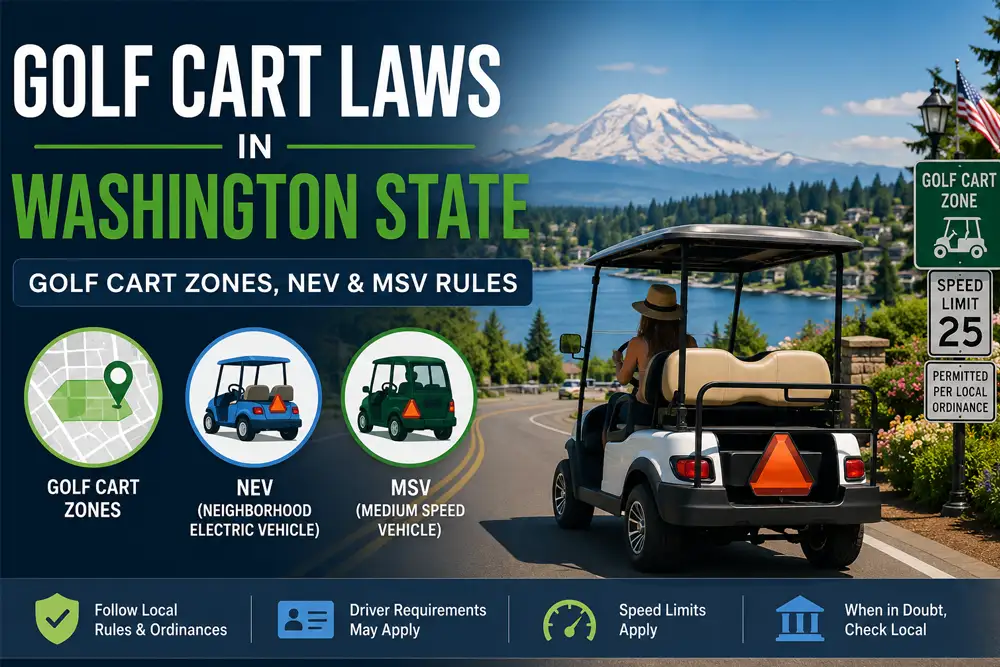
Washington state has one of the most structured golf cart frameworks in the country, built around three distinct vehicle categories that have meaningfully different road access rights. Understanding which category your vehicle falls into determines where you can legally drive it.
A standard golf cart (20 mph or less) can only operate inside a designated Golf Cart Zone created by a local city or county ordinance under RCW 46.08.175. Outside of those zones, driving a cart on any public street is illegal. Golf carts inside a zone are not registered with the Washington DOL and do not carry license plates.
Neighborhood electric vehicles (NEVs) and medium-speed vehicles (MSVs) are registered motor vehicles. Both must be registered and titled through the Washington DOL, carry insurance, and meet federal safety standards. In exchange, they have statewide road access on any street with a speed limit of 35 mph or less, without depending on a local Golf Cart Zone being in place.
Golf cart zones
25 mph max roads
NEV / MSV (registered)
35 mph max roads, statewide
Minimum age
16 (with driver ed or license)
Cart registration
Not required inside zones
NEV/MSV registration
Required through WA DOL
Insurance
Required for NEVs and MSVs
Washington’s three-tier vehicle system
Washington distinguishes golf carts, NEVs, and MSVs more clearly than most states, and the differences are not trivial. Each category has different registration requirements, road access, and equipment standards.
Golf cart
Top speed: 20 mph max
Road access: Golf Cart Zones only (25 mph streets)
Registration: Not registered with DOL
Insurance: Not required by state law (local ordinances vary)
NEV
Top speed: 25 mph max
Road access: Any road up to 35 mph statewide
Registration: Required through WA DOL
Insurance: Required
MSV
Top speed: 25 to 35 mph
Road access: Any road up to 35 mph statewide
Registration: Required through WA DOL
Insurance: Required
The MSV category under RCW 46.04.295 is unique to Washington and gives owners a higher-speed electric vehicle option within the low-speed framework. An MSV must be electrically powered, self-propelled, four-wheeled, and capable of speeds between 25 and 35 mph. It registers and insures like any motor vehicle and has the same statewide road access as an NEV.
How Golf Cart Zones work
RCW 46.08.175 is the statute that creates the Golf Cart Zone framework. It authorizes cities and counties to pass ordinances establishing designated zones where golf carts may legally operate on roads with speed limits of 25 mph or less. Each zone must be clearly identified with signs at its boundaries. Without that posted signage and the underlying ordinance, the zone does not legally exist and cart use on those roads is not authorized.
Inside a Golf Cart Zone, the cart must have seat belts, rearview mirrors, and reflectors. The operator must be at least 16 years old and either hold a valid driver’s license or have completed a driver’s education course. A full license is not technically required, but previous licensed driving experience or formal driver education is. Anyone whose license has been revoked under RCW 46.20.285 is prohibited from operating a cart on public roads even within a zone.
One Washington-specific requirement worth knowing: accidents involving golf carts within a Golf Cart Zone must be reported and tracked under RCW chapter 46.52 with the records specifically noting that a golf cart in a designated zone was involved. This is an administrative obligation that can catch people off guard after an incident.
NEV and MSV registration
If you want to drive beyond a Golf Cart Zone or your area does not have one, the NEV or MSV path is your route. Both require full registration and titling through the Washington DOL. You will need proof of ownership including a manufacturer’s certificate of origin or existing title, proof of Washington auto insurance, and a valid driver’s license. After registration you receive standard Washington license plates and can operate on any road with a posted speed limit of 35 mph or less statewide.
The required equipment for NEV and MSV registration includes headlights, taillights, brake lights, turn signals, rearview and side mirrors, seat belts, a windshield, a parking brake, a speedometer, and a manufacturer-assigned 17-digit VIN. Factory-built LSVs like the Denago Rover XL arrive with all of this from the manufacturer.
Frequently asked questions
Are golf carts street legal in Washington state?
Only inside designated Golf Cart Zones created by local city or county ordinance under RCW 46.08.175. Outside of those zones, operating a golf cart on any public street in Washington is illegal regardless of the posted speed limit. NEVs and MSVs registered with the Washington DOL have statewide road access on streets up to 35 mph.
What is a Golf Cart Zone in Washington state?
A designated area created by a local city or county ordinance under RCW 46.08.175 where golf carts may legally operate on roads with speed limits of 25 mph or less. Zones must be clearly marked with boundary signage. Carts in zones must have seat belts, mirrors, and reflectors, and operators must be 16 with driver education or license experience.
What is the difference between a golf cart, NEV, and MSV in Washington?
A golf cart (20 mph max) is limited to Golf Cart Zones and is not registered with the DOL. An NEV (25 mph max) and MSV (25 to 35 mph, electric only) are both registered motor vehicles with the DOL and have statewide road access on streets up to 35 mph without needing a local Golf Cart Zone.
Do I need a driver’s license to drive a golf cart in Washington?
A full driver’s license is not strictly required for golf carts in a Golf Cart Zone, but operators must be 16 and have completed driver’s education or have previous licensed driving experience. NEV and MSV operators must hold a valid driver’s license. Anyone with a suspended or revoked license cannot operate a golf cart on public roads regardless of zone status.
Is the Denago Rover XL street legal in Washington state?
Yes. It qualifies as an NEV under Washington definitions, registers with the Washington DOL, and can operate on roads up to 35 mph statewide. No local Golf Cart Zone is required for its use.
Do golf cart accidents in Washington need to be reported?
Yes. Accidents involving golf carts operating within Golf Cart Zones must be recorded and tracked under RCW chapter 46.52, with reports specifically noting that a golf cart in a designated zone was involved. This is a Washington-specific requirement.
This page is for general informational purposes only and is not legal advice. Golf cart and LSV laws change at the state and local level. Always verify current requirements with the Washington DOL and your local municipality before operating on public roads. Golf Cart Rating is not responsible for errors or omissions. Last reviewed June 2026.