

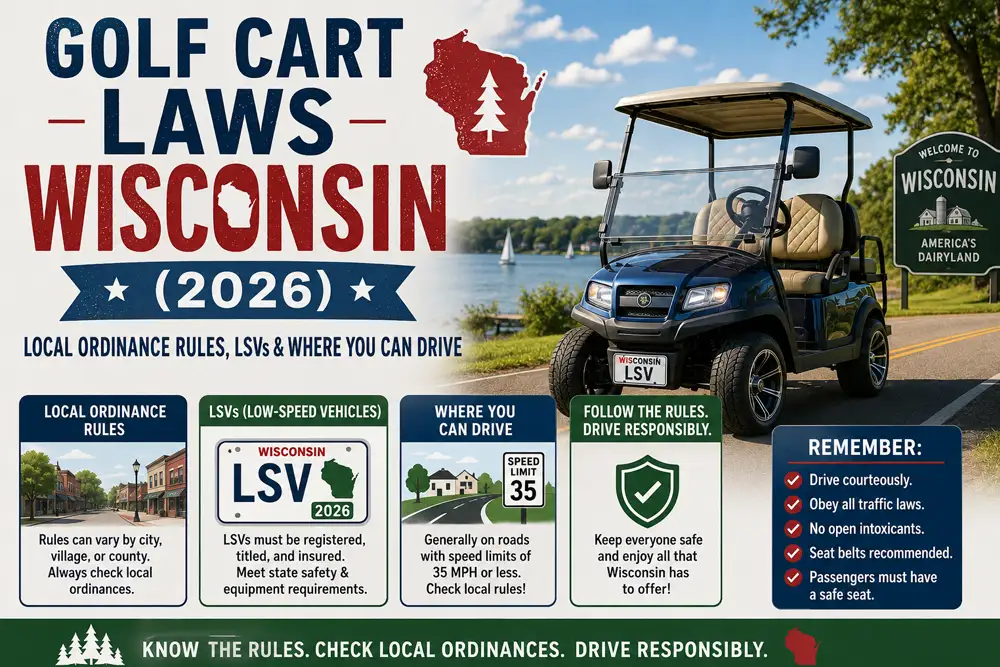
Article Summary
Wisconsin does not have a statewide law permitting golf carts on public roads. Whether you can drive a cart in your community depends entirely on whether your local municipality or county has passed an ordinance under Wisconsin Statute 349.18. Without that local authorization, driving a golf cart on a public street in Wisconsin is illegal, regardless of the speed limit.
Where a local ordinance does exist, it controls everything: which roads are permitted, what equipment the cart must have, minimum driver age, whether a local permit is required, and whether insurance is mandatory. The rules can look completely different from one town to the next.
Factory-built LSVs are treated separately by the Wisconsin DOT. A vehicle that meets federal FMVSS 500 standards, has a manufacturer-assigned 17-digit VIN, and is registered with the Wisconsin DMV can operate on roads up to 35 mph statewide without needing a local ordinance.
Statewide street legal
No (local ordinance required)
Max road speed limit
25 mph (where allowed)
Minimum age
Set by local ordinance
Registration
Local permit (varies)
Insurance
Varies by ordinance
Driver’s license
Set by local ordinance
How Wisconsin golf cart law actually works
The core statute to know is Wisconsin Statute 349.18. It gives municipalities and counties the authority to pass local ordinances allowing golf carts on roads with posted speed limits of 25 mph or less. The key word there is authority. The state is not granting blanket permission, it is allowing local governments to make their own call. If your city or town has not passed an ordinance, cart use on public roads is not legal regardless of what you see your neighbors doing.
When a municipality does pass an ordinance, that document becomes the governing rulebook for everything related to cart use in that jurisdiction. It specifies which roads carts can use, what equipment is required, the minimum age, whether a permit is needed, and any insurance requirement. Two neighboring towns in Wisconsin can have completely different answers to the same question, which is why calling your local city hall before you drive is not optional.
What local ordinances typically require
While the specifics vary, Wisconsin municipalities that have passed ordinances tend to require similar things. Most require the cart operator to have a valid driver’s license or be of a certain minimum age, usually 16. Many require basic safety equipment including headlights and taillights for any use near dusk or dawn, a slow-moving vehicle emblem, and a rearview mirror. Some municipalities issue a local golf cart permit that you must obtain and display. A handful require proof of liability insurance as part of the permit application.
The road access is typically limited to streets with speed limits of 25 mph or lower, and carts are generally expected to yield to all other traffic. Night driving is usually restricted or prohibited unless the local ordinance specifically addresses it and the cart has proper lighting.
LSVs in Wisconsin: a different category
Wisconsin DOT draws a clear line between a golf cart operating under a local ordinance and a vehicle that qualifies as an LSV or neighborhood electric vehicle. A factory-built LSV with a manufacturer-assigned 17-digit VIN and full FMVSS 500 safety equipment is treated like a motor vehicle by the state. It can be titled and registered with the Wisconsin DMV, carries standard motor vehicle insurance, and can operate on roads with speed limits up to 35 mph without depending on a local ordinance.
This is a meaningful distinction if you live in an area where no local ordinance has been passed, or where the ordinance only covers very limited roads. A registered LSV opens up considerably more of the road network.
Where golf carts are actively used in Wisconsin
The communities with the most established golf cart culture in Wisconsin tend to be resort towns and lake communities where ordinances have been in place for years. Door County is one of the most active areas, with several municipalities permitting cart use on local roads. Lake Geneva has a well-established cart presence, particularly around the resort areas. Wisconsin Dells and Minocqua in the north attract visitors who use carts to move around the resort corridors. Many smaller lake communities throughout northern Wisconsin have also passed ordinances as cart use has grown.
If you are buying a cart specifically for use in one of these communities, it is still worth confirming the current ordinance before your purchase. Rules do get updated, and what was permitted three years ago may have new conditions attached.
Frequently asked questions
Are golf carts street legal in Wisconsin?
Not automatically. Wisconsin Statute 349.18 allows municipalities and counties to pass local ordinances authorizing golf cart use on roads with speed limits of 25 mph or less. Without a local ordinance in your area, driving a golf cart on a public street in Wisconsin is not legal.
How do I find out if my Wisconsin city or town allows golf carts?
Contact your city hall, village office, or county clerk directly and ask whether a golf cart ordinance under Wisconsin Statute 349.18 is in place. The ordinance will tell you which roads are permitted, what equipment you need, age requirements, and whether a local permit is required.
What is the difference between a golf cart and an LSV in Wisconsin?
A golf cart operating under a local ordinance does not go through the Wisconsin DMV registration process. An LSV that meets federal FMVSS 500 standards, has a manufacturer-assigned 17-digit VIN, and is registered with the Wisconsin DMV can operate on roads up to 35 mph statewide without needing a local ordinance.
Do I need insurance to drive a golf cart in Wisconsin?
It depends on your local ordinance. Some municipalities require proof of insurance as part of the local permit process. LSVs registered with the Wisconsin DMV require standard motor vehicle insurance. Even when not legally required, a standalone golf cart liability policy is strongly recommended.
Is the Denago Rover XL street legal in Wisconsin?
The Denago Rover XL is a factory-built LSV that can be registered with the Wisconsin DMV as a motor vehicle. It can operate on roads with speed limits up to 35 mph in areas where LSVs are authorized, which is a broader path than the local golf cart ordinance route.
Where in Wisconsin are golf carts commonly used?
Door County, Lake Geneva, Wisconsin Dells, and Minocqua are among the most active markets. Many lake communities throughout northern Wisconsin have passed ordinances as well. Always confirm the current local ordinance before driving in any new area.
This page is for general informational purposes only and is not legal advice. Golf cart laws change at the state, county, and municipal level. Always verify current requirements with your local municipality and the Wisconsin DOT before operating on public roads. Golf Cart Rating is not responsible for errors or omissions. Last reviewed June 2026.