
Article Summary
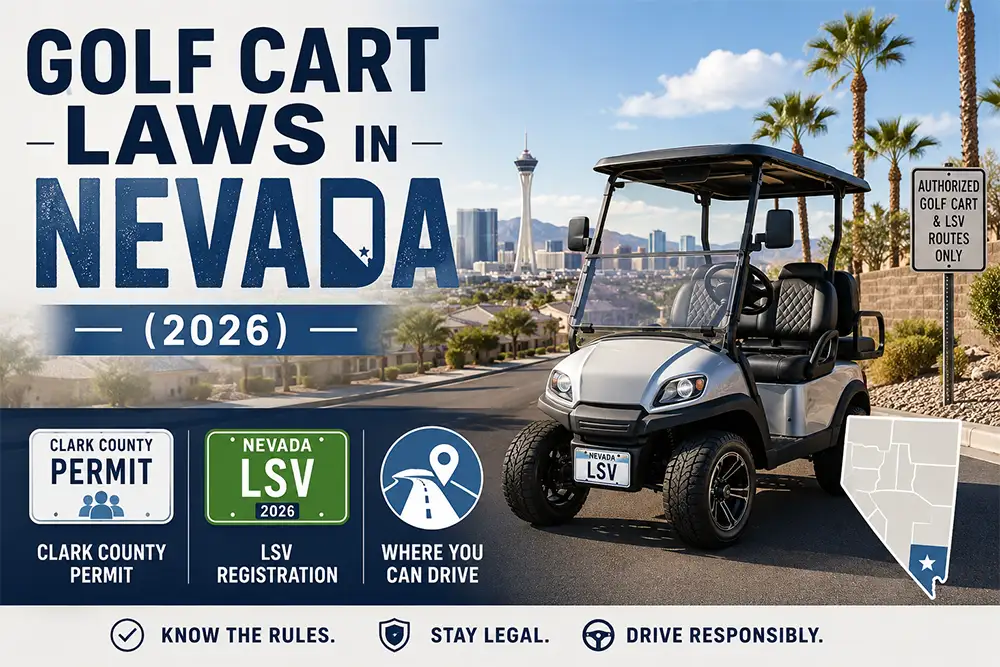
Nevada golf cart law splits into two tracks based on where you live. In Clark County, which covers Las Vegas, Henderson, and the surrounding area, you need a DMV-issued permit and insurance to operate a golf cart on public roads in approved residential developments. In counties with fewer than 700,000 residents, a formal permit is not required as long as you meet specific no-permit conditions including daylight-only operation and roads with speed limits of 25 mph or less.
Standard golf carts in Nevada are not registered through the DMV the way a car or truck would be. That is a separate process that applies to LSVs. Factory-built LSVs like the Denago Rover XL go through full Nevada DMV title and registration and can operate on any road with a speed limit of 35 mph or less statewide, which is a meaningfully broader authorization than the golf cart permit path.
A valid driver’s license is required to operate a golf cart on public roads in Nevada under NRS 482.398, regardless of which county you are in.
Street legal
Yes (conditions apply)
Max road speed limit
25 mph (carts) / 35 mph (LSVs)
Minimum age
16 (license required)
Registration
DMV permit (Clark) / conditions (other counties)
Insurance
Required (Clark County)
Driver’s license
Required (NRS 482.398)
How Nevada splits golf cart rules by county
Nevada Revised Statute 482.398 is the governing law for golf cart use on public roads in Nevada, and it draws a line based on county population of 700,000. Currently, only Clark County (Las Vegas metro) crosses that threshold.
Clark County (700,000+ population)
A DMV-issued permit is required to operate a golf cart on public roads in approved residential developments. The permit requires proof of Nevada insurance. Cart use is authorized in those specific approved areas, not on public roads generally throughout the county.
All other Nevada counties
No formal permit is required if you meet these conditions: daylight hours only, roads with speed limits of 25 mph or less, required safety equipment installed, and a valid driver’s license. Local authorities may add additional conditions.
In both cases, golf carts in Nevada are not registered through the DMV’s standard vehicle registration process. The DMV permit in Clark County is not the same as a vehicle title or registration. Standard golf carts are not titled through the Nevada DMV.
Required equipment
Whether you are operating under the Clark County permit system or the smaller-county no-permit conditions, Nevada golf carts operating on public roads are generally expected to have the following:
- Headlights (required for any operation near dawn or dusk)
- Taillights and brake lights
- Reflectors
- Rearview mirror
- Horn
- Valid driver’s license for the operator
- Nevada insurance (required in Clark County)
LSVs must additionally meet full FMVSS 500 requirements including turn signals, seat belts, a windshield, side mirrors, a parking brake, and a manufacturer-assigned 17-digit VIN.
LSV registration in Nevada
Factory-built LSVs follow a completely different path from standard golf carts. An LSV must have a manufacturer-assigned 17-digit VIN and meet all federal FMVSS 500 safety standards. It goes through standard Nevada DMV title and registration just like any other motor vehicle, and it must carry Nevada auto insurance before registration can be completed.
The benefit of LSV registration is statewide road access on any street with a speed limit of 35 mph or less, without needing a local permit, an approved residential development designation, or a county-specific workaround. Retirement communities in Henderson, Sun City Summerlin, and Mesquite all have residents using registered LSVs for local transportation.
Where golf carts are commonly used in Nevada
Henderson is the most active market. Several planned communities there have established cart-friendly infrastructure and active LSV use. Sun City Summerlin, a large retirement community on the northwest side of Las Vegas, has a significant golf cart and LSV presence. Mesquite, about 80 miles northeast of Las Vegas near the Utah border, has a smaller but established community of cart users. Laughlin, the casino town on the Colorado River border, also has cart use around its resort corridors.
If you are in the Las Vegas metro and want to drive a cart to run local errands or navigate a retirement community, the LSV registration route gives you the most flexibility and the fewest restrictions on which specific roads you can use.
Frequently asked questions
Are golf carts street legal in Nevada?
It depends on your county. In Clark County, you need a DMV-issued permit and insurance to operate in approved residential developments. In smaller counties, no permit is required if you operate during daylight, on roads with speed limits of 25 mph or less, and with required equipment. LSVs registered with the Nevada DMV can use roads up to 35 mph statewide.
How do I get a golf cart permit in Clark County, Nevada?
Golf cart permits in Clark County are issued through the Nevada DMV under NRS 482.398. The permit requires proof of Nevada insurance and is specific to approved residential developments. It does not authorize general public road use throughout the county.
Do I need a driver’s license to drive a golf cart in Nevada?
Yes. Under NRS 482.398, a valid driver’s license is required to operate a golf cart on public roads in Nevada. The effective minimum age is 16, which is the standard licensing age in the state.
What is the difference between a golf cart and an LSV in Nevada?
A golf cart does not have a VIN and does not go through standard DMV vehicle registration. An LSV has a manufacturer-assigned 17-digit VIN, meets FMVSS 500 standards, and registers through the Nevada DMV as a motor vehicle. LSVs can operate on any road with a speed limit of 35 mph or less statewide.
Is the Denago Rover XL street legal in Nevada?
Yes. It is a factory-built LSV that registers through the Nevada DMV and can operate on roads up to 35 mph statewide. It is a more flexible option than the Clark County golf cart permit route.
Do I need insurance for a golf cart in Nevada?
Insurance is required in Clark County as part of the DMV permit process. LSVs must carry Nevada auto insurance to complete DMV registration. Even in smaller counties where insurance is not explicitly mandated for golf carts, liability coverage is strongly recommended.
This page is for general informational purposes only and is not legal advice. Golf cart laws change at the state, county, and local level. Always verify current requirements with the Nevada DMV and your local authority before operating on public roads. Golf Cart Rating is not responsible for errors or omissions. Last reviewed June 2026.